
Reading Guide for Book Clubs
10 ESSENTIAL QUESTIONS
WARM UP
1. What was your overall reaction to the book? What idea, image, or argument stayed with you most?
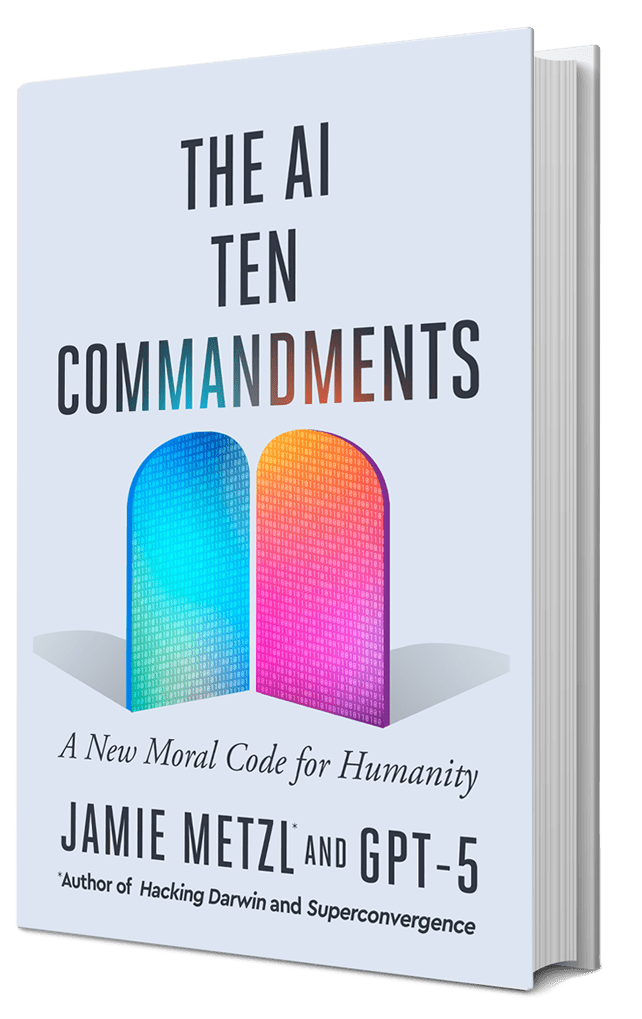
2. This book was written in Jamie Metzl’s voice but co-authored by Metzl and GPT-5. How did that affect your experience as a reader? Did it change what you trusted, questioned, or felt?
COLLABORATION AND CREATIVITY
3. In the introduction, Metzl describes how he and GPT-5 collaborated. What did that partnership make you think about the future of creativity (human creativity, human+AI creativity, and AI-generated creativity)?
4. Would you want an AI co-pilot in your daily life? Where would you welcome it most, and where would you draw a hard boundary?
THE BOOK’S CORE CLAIMS
5. The book argues that our moral evolution must accelerate alongside our rapidly advancing technological capabilities. Do you agree? Where do you see the gaps between technology, power, and wisdom most clearly today?
6. Metzl suggests the AI Ten Commandments are not otherworldly declarations, but distillations of human moral traditions across millennia. Did that framing make the new commandments more credible to you—or less?
THE COMMANDMENTS
7. How did you feel about an AI system reimagining one of the most foundational ethical documents in the Judeo-Christian tradition?
8. Comparing the biblical Ten Commandments and the AI Ten Commandments side-by-side, which resonated with you more. Why? Which new commandment resonated most with you personally? Which challenged you the most?
9. The book presents the AI Ten Commandments as a supplement to older moral codes (including the Biblical Ten Commandments), not a replacement. Do you agree with that approach? Why or why not?
CLOSING/MEANING
10. In the conclusion, Metzl invokes Borges’s idea of imagined worlds becoming real. Do you believe we can dream a better future and then begin inhabiting it? What would that require of people like us?