
A Clergy Guide
to Preaching with The Ten AI Commandments
THEMES, STRUCTURES & SERMON PATHWAYS
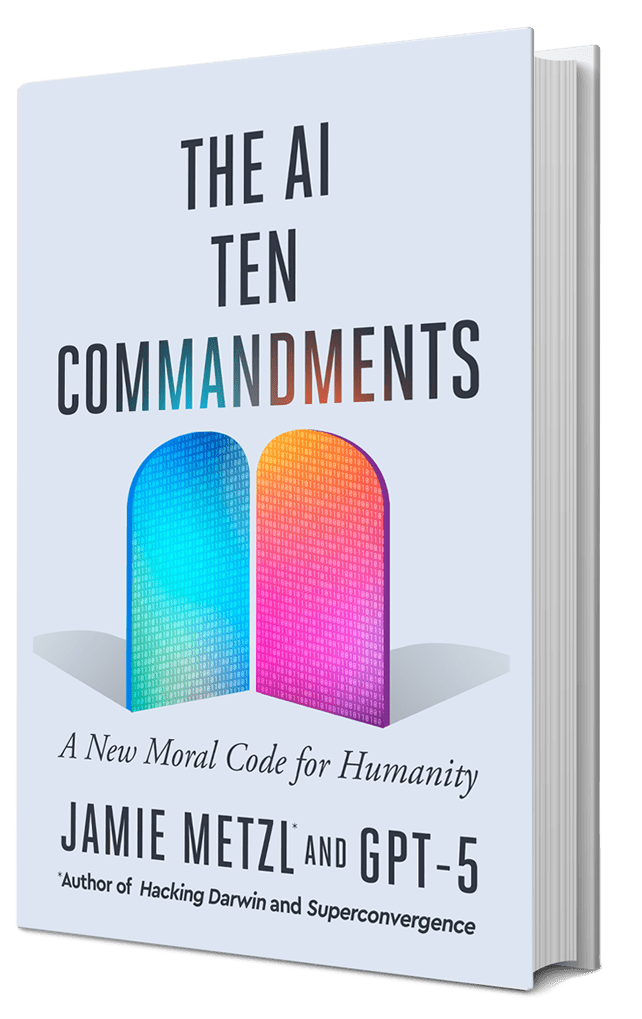
The guide below is offered to members of the clergy and other religious/spiritual leaders who wish to use The AI Ten Commandments as a theological and ethical conversation partner in sermons, homilies, chavurahs, teachings, and study groups.
Free eBook
Clergy wishing to use The AI Ten Commandments as a jumping-off point for sermons can request a free digital copy of the book.
A Clergy Guide to The Ten AI Commandments
1. MORAL POWER WITHOUT MORAL GROWTH
Core Sermon Question: What happens when our power to act grows faster than our wisdom to choose?
Throughout the book, Metzl argues that humanity’s technological acceleration has repeatedly outpaced its moral evolution. From controlled fire to industrialization to artificial intelligence, each leap in capability has magnified both our capacity to heal and to harm.
In sermons, clergy might draw on this theme to explore:
- The spiritual danger of unchecked power
- The ethical responsibility that accompanies new tools
- The recurring biblical and religious warning against hubris
Illustrative example from the book:
Metzl notes that AI can simultaneously enable life‑saving medical breakthroughs and industrial‑scale disinformation and violence. The moral question is not whether AI is good or evil, but whether humans will grow wise enough to wield it responsibly.
Possible homiletic pairing:
- The Tower of Babel
- The Golden Calf
- The temptation narratives
- Teachings on stewardship and restraint
2. COMMANDMENTS AS MIRRORS, NOT WEAPONS
Core Sermon Question: Are our moral codes meant to discipline ourselves or to dominate others?
In revisiting the biblical Ten Commandments, the book emphasizes how moral laws can either serve as guides for humility and self‑restraint or be weaponized to justify exclusion, violence, and moral superiority.
Metzl’s critique of commandments that claim exclusive access to truth opens space for sermons on pluralism, humility, and moral fallibility.
Illustrative example from the book:
The discussion of the Second Commandment traces how claims of a single, exclusive truth have sometimes been interpreted as fueling religious violence—from biblical conquest narratives to the Crusades—while contrasting this with the tradition of treating the dictates of the Second Commandment specifically and of moral law generally as inward discipline.
Sermon emphasis:
- Moral law as self‑examination
- The danger of turning faith into coercion
- Compassion as the true test of belief
3. TECHNOLOGY AS A CO-AUTHOR OF MORAL HISTORY
Core Sermon Question: How have our tools always shaped the way we understand right and wrong?
One of the book’s central insights is that moral systems do not emerge in isolation. Alphabetic writing made the original Ten Commandments possible. The printing press reshaped religion, authority, and conscience. Digital technologies now reshape attention, truth, community, and identity.
Illustrative example from the book:
Metzl argues that without alphabetic writing, the Ten Commandments could not have been preserved, shared, or normalized in the same way, highlighting the critical point that technology has always mediated many aspects of revelation.
Sermon application:
- Technology as amplifier, not originator, of moral insight
- Recognition of the connection between technological and religious/spiritual development
- Discernment about how new media shape belief
- Responsibility for the moral ecosystems we build
4. HUMAN DIGNITY IN A MACHINE AGE
Core Sermon Question: What does it mean to affirm human dignity when machines can increasingly see, think, create, and act?
Across chapters on surveillance, automation, and AI perception, the book repeatedly returns to the risk of eroding human agency and dignity.
Illustrative example from the book:
In discussing AI’s ability to ‘see’ us—through data, patterns, and prediction—Metzl warns that when people become legible only as data points, moral imagination contracts.
Sermon directions:
- Humans as more than metrics
- The sacred irreducibility of persons
- Protecting the soul in a quantified
5. AI AS A MORAL MIRROR
Core Sermon Question: What do we learn when a machine trained on our history reflects our values back to us?
The AI Ten Commandments are explicitly framed not as divine decrees, but as distilled patterns drawn from humanity’s accumulated moral traditions.
Illustrative example from the book:
When GPT‑5 generates principles emphasizing dignity, responsibility, and restraint, the book asks whether these values surprise us or simply remind us of truths we already know but too often ignore.
Homiletic framing:
- AI as mirror, not prophet
- Accountability for what we have taught our machines
- Recognition of our failures and shortcoming as moral recalibration
6. HOPE WITHOUT NAIVETY
Core Sermon Question: Can hope grow and guide in a world of real technological danger?
Unlike dystopian or utopian AI narratives, the book insists on moral agency. The future is not pre‑written but shaped by our choices.
Illustrative example from the conclusion:
Invoking Borges’s imagined worlds becoming real, Metzl suggests that ethical imagination is itself a moral act that precedes moral change.
Sermon emphasis:
- Hope as responsibility, not wishful thinking
- Ethical imagination as sacred work
- Choosing who we become
AFFIRMATION FROM RELIGIOUS LEADERS
Rabbi Angela Buchdahl has described the book as “less a substitute for Sinai than a contemporary midrash—a thoughtful invitation to meet new technology with accountability, wisdom, and the courage to choose a better future.”
Msgr. Carlo Maria Polvani of the Vatican Dicastery for Culture and Education has called it “a remarkable moral response to the epochal transformations our world is undergoing.”
These reflections underscore that the book is being received not as a challenge to faith, but as a serious ethical companion.
DISCUSSION GROUP QUESTIONS
The AI Ten Commandments is being embraced by book clubs and conversation groups across the country. If you would like to organize such an event, you might explore the following questions:
Warm-Up
1. What was your overall reaction to the book? What idea, image, or argument stayed with you most?
2. This book was written in Jamie Metzl’s voice but co‑authored by Metzl and GPT-How did that affect your experience as a reader? Did it change what you trusted, questioned, or felt?
Collaboration and Creativity
3. In the introduction, Metzl describes how he and GPT‑5 collaborated. What did that partnership make you think about the future of creativity (human creativity, human+AI creativity, and AI‑generated creativity)?
4. Would you want an AI co‑pilot in your daily life? Where would you welcome it most, and where would you draw a hard boundary
The Book’s Core Claims
5. The book argues that our moral evolution must accelerate alongside our rapidly advancing technological capabilities. Do you agree? Where do you see the gaps between technology, power, and wisdom most clearly today?
6. Metzl suggests the AI Ten Commandments are not otherworldly declarations, but distillations of human moral traditions across millennia. Did that framing make the new commandments more credible to you—or less?
The Commandments
7. How did you feel about an AI system reimagining one of the most foundational ethical documents in the Judeo‑Christian tradition?
8. Comparing the biblical Ten Commandments and the AI Ten Commandments side‑by‑side, which resonated with you more. Why? Which new commandment resonated most with you personally? Which challenged you the most?
9. The book presents the AI Ten Commandments as a supplement to older moral codes (including the Biblical Ten Commandments), not a replacement. Do you agree with that approach? Why or why not?
Closing/Meaning
10. In the conclusion, Metzl invokes Borges’s idea of imagined worlds becoming real. Do you believe we can dream a better future and then begin inhabiting it? What would that require of people like us?
A CLOSING WORD TO CLERGY
Faith leaders have always helped societies interpret and remain centered through moments of upheaval. Although many members of the clergy may not be fully up to speed on every aspect of AI or other technologies, your moral voice is more relevant to the future of humanity than any lines of code.
While clergy can and should highlight the many real dangers associated with these technologies, you also have an opportunity to articulate how these same capabilities can be leveraged to build a better world.
After some initial resistance in many cases, every major world religion has embraced the capabilities of the printing press to share ideas and build communities. Our new technologies will create the same types of opportunities and more, but they will not do this on their own.
The AI Ten Commandments is offered to clergy as a tool for discernment that invites deep theological reflection, honest moral reckoning, and renewed commitment to human flourishing in our rapidly changing world.